_6qQGT7RyIS2hBzkugHCoc.png?width=2048&quality=80&format=auto)
EU and Switzerland Sign Electricity Agreement: Implications for Switzerland
Switzerland and the EU have concluded a landmark electricity agreement to integrate Swiss grid and markets into the EU internal electricity market. This special analysis examines the structural drivers behind the deal—including the 2022 winter supply crisis and the discriminatory "70% rule"—and analyzes the trade-off between guaranteed market access and the loss of regulatory autonomy under dynamic alignment with EU law.
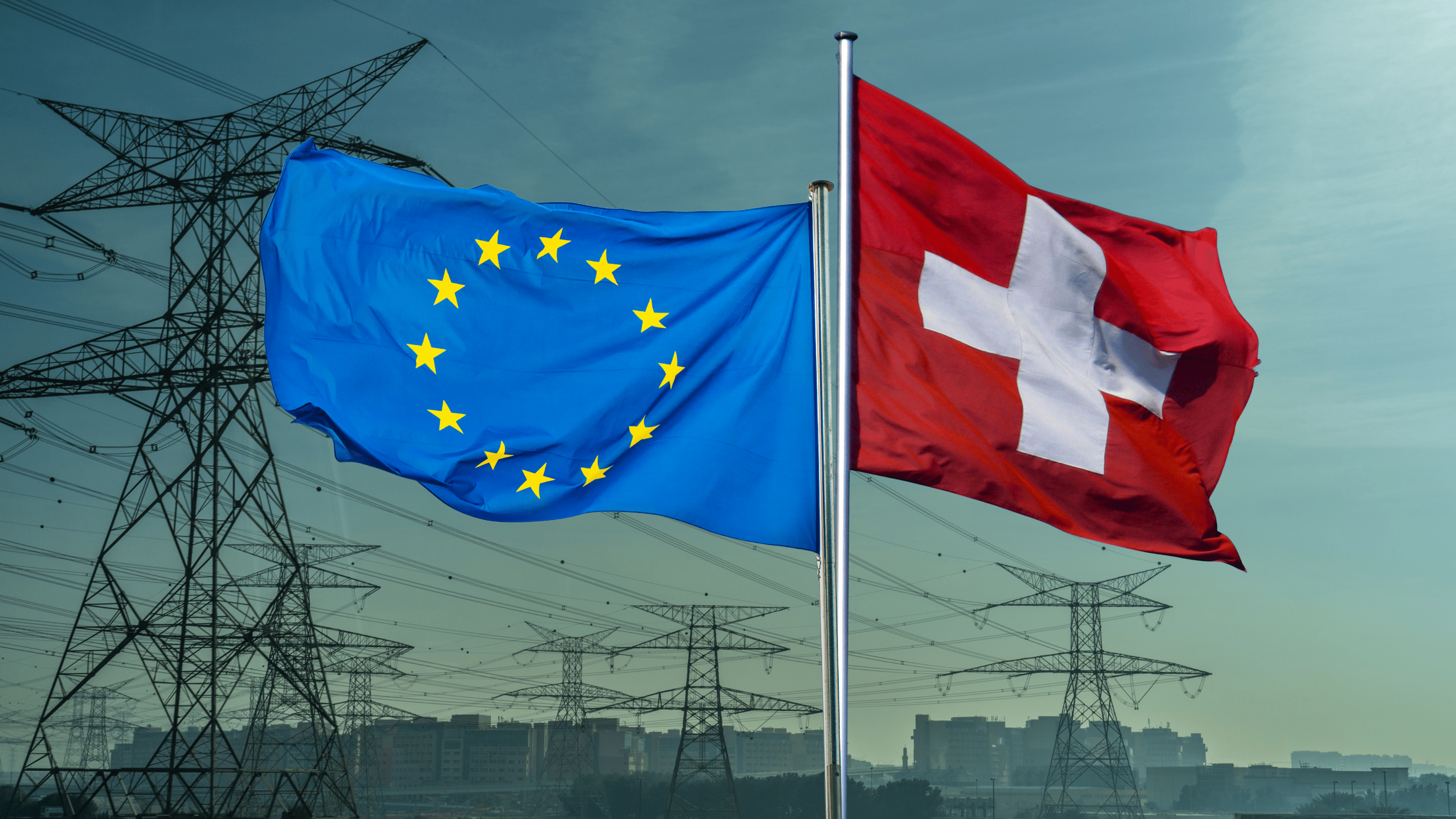
After nearly two decades of negotiation, regulatory divergence, and political brinkmanship, Switzerland and the European Union have now concluded the Agreement on Electricity. This treaty represents a fundamental change in how Swiss electricity is bought, sold, and regulated. For the first time, Switzerland will directly participate in the EU's centralized electricity trading platforms. Swiss regulators will sit in European regulatory bodies. And Switzerland will automatically adopt future changes to EU electricity law.
The implications for Switzerland are immediate and structural: the removal of the 100,000 kWh threshold for Swiss consumers, the integration of Swissgrid into EU capacity calculation regions, and the introduction of a robust new compliance regime under Swiss REMIT. This analysis dissects the treaty's architecture, identifying the critical risks, operational shifts, and political fault lines that will define the next decade of Swiss-EU energy relations.
The treaty exists because Switzerland faced three concrete, interlocking problems that could only be solved through deep legal integration with the EU. This article explains those problems, analyzes the treaty's legal structure, and examines what the treaty requires Swiss and EU energy companies to change.
Switzerland's electricity system depends on imported electricity during winter months. This is not a preference or a trading strategy. It is a physical necessity.
Over 60% of Switzerland's electricity comes from hydropower. Hydropower generation is highest in spring and summer, when Alpine snowmelt feeds rivers and reservoirs. Generation falls sharply in winter. At the same time, electricity demand rises in winter because of heating and reduced daylight. The result is a structural gap: in eight of the last ten winters, Switzerland has consumed more electricity than it produced domestically.
The numbers are large. Switzerland imports between 5 and 9 terawatt-hours (TWh) of electricity per winter. To put this in perspective: Switzerland's total annual electricity consumption is approximately 65 TWh. So each winter, Switzerland imports 8% to 14% of its total annual electricity needs in a period of just four months. For industrial consumers and the economy as a whole, reliable winter imports are as essential as reliable domestic generation.
This was always true, but it became an acute political problem in 2022-2023. That winter, European electricity prices reached unprecedented levels. Russia had restricted gas supplies to Europe. French nuclear plants were offline for maintenance. Hydropower across the continent suffered from drought. EU electricity prices exceeded €300 per megawatt-hour in some regions, compared to €50 per MWh in 2020.
Switzerland faced the risk that it could not secure imports at any price. The Federal Government moved to emergency measures. It established a strategic hydropower reserve of 400 gigawatt-hours. It contracted temporary coal-fired power plants as backup generation. It created a CHF 4 billion financial assistance program for utilities to cover margin calls from volatile electricity markets. Officials publicly warned of the risk of rolling four-hour blackouts across regions if the winter proved severe.
This was a shock to Swiss policymakers. Switzerland had always assumed it could purchase electricity from neighbors when needed. The 2022 crisis showed that assumption was not reliable. Europe's energy supply was tight. Switzerland's neighbors had no legal obligation to reserve capacity for Swiss imports. The government concluded that Switzerland needed a legal guarantee of reliable access to electricity markets.
The second problem was specific and legal. In 2019, the EU adopted the Clean Energy Package, including new rules on how electricity can be traded across borders. A key rule requires EU electricity transmission companies to make at least 70% of their cross-border capacity available for trading between EU countries.
This rule has a direct consequence for Switzerland: when an EU transmission company faces congestion on a border, it must prioritize 70% of available capacity for trades between EU countries. The remaining 30% (or less, depending on circumstances) can be used for trades with Switzerland.
Before this rule existed, Switzerland could negotiate with each neighboring country (Germany, France, Italy, Austria) about how much capacity would be available for Swiss electricity imports. After the rule was adopted, Switzerland's access to that capacity became subordinate to EU internal trades.
Consider a realistic winter scenario: It is February. A cold spell has hit Central Europe. German electricity demand is high. Simultaneously, Italian utilities need to import electricity from Germany (Germany has wind power; Italy faces a production shortfall). An EU transmission company in Germany—say Amprion or TransnetBW—faces congestion on its interconnectors. Under the 70% rule, Amprion must allocate 70% of available capacity for the Germany-to-Italy trade. Only 30% remains available for Switzerland.
If Switzerland is trying to import electricity at the same time, Swiss importers would face a 30% capacity reduction, precisely when they need electricity most. And Switzerland has no legal recourse to challenge this. The EU rule does not treat Switzerland as part of the internal market. It treats Switzerland as external to the market.
For Swiss utilities and industrial consumers, this is not an abstract legal issue. It is a real commercial risk. A manufacturer depending on reliable winter electricity could face forced curtailment of 30% or more, with no contractual recourse. This is not speculative. It is the logical consequence of the EU's rules as they existed.
The Agreement solves this by integrating Swiss interconnectors into the EU's capacity calculation. Switzerland is no longer "external." Swiss cross-border flows now count toward the 70% target. EU transmission companies cannot discriminate against Switzerland in the name of serving other EU countries. The result is a legal guarantee of non-discriminatory capacity access.
The third problem was about trading efficiency.
Since 2014, the EU has operated a centralized electricity exchange called the Single Day-Ahead Coupling (SDAC). This is a computerized system that automatically matches electricity buyers and sellers across 27 EU countries. Every day, the SDAC algorithm runs and allocates electricity and transmission capacity simultaneously, optimizing the overall European supply. This system is far more efficient than having countries trade electricity bilaterally, country by country.
In 2018, the EU added the Single Intraday Coupling (SIDC), which allows traders to buy and sell electricity continuously throughout the day as new information arrives, up until just before delivery.
Switzerland was excluded from both systems. Swiss traders could not submit bids into the SDAC or SIDC. Instead, they had to negotiate explicit capacity auctions with each neighboring country's transmission company, and then negotiate separate energy trades. This is slow, expensive, and inefficient.
The consequence was a price gap. Electricity prices in Switzerland were consistently different from EU prices, even when there was physical capacity available to import electricity. A Swiss buyer might have to pay a 5% to 15% premium to purchase EU electricity, simply because of the trading mechanism, not because of scarcity. That premium represents hundreds of millions of euros annually in hidden costs to Swiss consumers and businesses.
There was also an opportunity cost for the EU. Switzerland has approximately 9,000 megawatts of pumped hydroelectric storage capacity. Pumped storage is ideal for balancing electricity markets: during hours of abundant wind and solar generation, excess electricity pumps water uphill into reservoirs; during peak demand hours, that water flows downhill through turbines to generate electricity. This "battery" is extremely valuable in a continent increasingly dependent on intermittent renewables like wind and solar.
But because Switzerland was excluded from the SDAC and SIDC, Swiss pumped hydro facilities could not efficiently participate in the EU's balancing markets. Swiss hydropower sat idle during hours when the EU desperately needed it. The EU had to use more expensive alternative balancing mechanisms. The cost was borne by EU consumers.
The Agreement solves this by giving Switzerland full access to the SDAC and SIDC. Swiss traders can now submit bids directly. Swiss pumped hydro can be marketed for balancing services across Europe. The price gap between Switzerland and the EU will narrow or disappear. The EU gains access to a major source of flexible generation.
The fourth problem was physical: Switzerland's position in the middle of Europe meant that electricity flowing between other countries necessarily passed through Swiss territory, even if Switzerland had nothing to do with that trade.
Consider this: France wants to sell electricity to Italy. The cheapest physical route is France → Switzerland → Italy. But under EU trading rules, the trade is supposed to be direct (France to Italy). If the trade cannot be routed directly due to congestion, electricity still flows physically through Switzerland. This creates an "unplanned flow".
Switzerland's transmission company, Swissgrid, had to manage these unplanned flows to keep the grid stable. When unplanned flows caused congestion on Swiss lines, Swissgrid would pay generators to reduce output (or pay other countries to increase output) to relieve the congestion. This is called "redispatch." Redispatch is expensive. It involves real-time negotiations, out-of-market transactions, and inefficiency. Swissgrid's redispatch costs have grown with the volume of unplanned flows.
More importantly, unplanned flows were a safety risk. In January 2021, a grid separation event in Croatia cascaded across Europe. Swissgrid had to physically disconnect Switzerland from the Continental grid to prevent a continent-wide blackout. The incident was resolved, but it demonstrated that operating a physically integrated grid under fragmented legal rules creates serious risks.
The Agreement solves this by fully integrating Swiss flows into the EU's capacity calculations. Swissgrid will no longer experience the same level of unplanned flows. Grid management becomes more precise. Redispatch costs decline. System stability improves.
Before the Agreement, Switzerland faced concrete operational limitations:
Switzerland could not guarantee reliable winter electricity imports. Neighboring countries had no legal obligation to reserve capacity. In extreme situations, they could legally prioritize internal EU trades over Swiss imports.
Switzerland could not access centralized EU electricity trading platforms. Swiss traders could not bid into the SDAC or SIDC. Swiss hydropower could not be efficiently marketed as a balancing resource.
Switzerland could not participate meaningfully in EU electricity regulation. When the EU adopted new electricity rules—new network codes, new market design requirements, new compliance standards—Switzerland had to adopt them unilaterally, with no input into their design.
Switzerland had no legal framework to resolve disputes with the EU over electricity matters. If Switzerland believed an EU rule unfairly burdened Swiss electricity companies, there was no treaty mechanism to appeal it.
Swiss utilities could not plan long-term investments with confidence. Without a binding legal framework, the rules of cross-border electricity trade could change year to year. This uncertainty depressed investment in Swiss transmission infrastructure and storage capacity.
The Agreement removes all of these constraints.
In exchange for the benefits described above, Switzerland is making four commitments:
Switzerland must adopt and maintain all of the EU's electricity rules. This includes the Third Energy Package (the foundational EU rules on electricity market liberalization from 2009) and the Clean Energy Package (the updated rules from 2019).
These rules are detailed and extensive. They cover market design (how electricity is bought and sold), grid operation (how transmission companies manage the network), consumer protection (how retail electricity customers are protected), renewable energy support, and many other topics.
This is the most significant commitment. Switzerland is not simply adopting current EU law. It is committing to automatically adopt future changes to EU electricity law. If the EU passes new electricity legislation five years from now, Switzerland must adopt it. This happens through an automated process, not through renegotiation.
This creates a political challenge for Switzerland. It means that future Swiss energy policy will be shaped by Brussels, not Bern. Swiss policymakers will have no vote on new EU electricity rules. They will have only limited input into the negotiation process.
The treaty attempts to mitigate this through a governance structure. The Swiss electricity regulator, ElCom, can participate in EU regulatory bodies and offer input. But ElCom does not have voting rights. Switzerland is, in this context, a "rule-taker," not a "rule-maker".
Switzerland has enacted domestic legislation called the Swiss REMIT, aligned with the EU's Regulation on Wholesale Energy Market Integrity and Transparency. This rule prohibits market manipulation and insider trading in electricity markets. It requires extensive reporting of all electricity trades to regulators.
The consequences of violation are severe. Regulators can impose administrative fines of up to 15% of a company's turnover. For a large utility, this could mean fines in the hundreds of millions of francs.
This is not mere regulatory compliance. It is a fundamentally different operational model. Swiss traders now operate under the same surveillance and enforcement regime as EU traders. Their email communications can be reviewed. Their trading algorithms can be audited. Their historical trades can be reconstructed and analyzed for evidence of manipulation.
If disputes arise about the meaning of EU law concepts, those disputes can be referred to the Court of Justice of the European Union (CJEU) for a binding ruling. This is politically sensitive in Switzerland because it means a non-Swiss court interprets the limits of Swiss energy law.
The treaty involves clear trade-offs.
What Switzerland Gains:
Switzerland gains guaranteed, non-discriminatory access to EU electricity markets. This removes the risk that neighboring countries will restrict Swiss imports during tight supply situations. It removes the legal uncertainty around the 70% rule. It allows Swiss utilities and consumers to purchase electricity at more competitive prices through access to centralized trading platforms. It allows Swiss hydropower to generate additional revenue from EU balancing services.
What Switzerland Loses:
Switzerland loses the ability to independently regulate its electricity market. Swiss policymakers cannot adopt different rules than the EU. If the EU moves in a direction Switzerland dislikes, Switzerland cannot opt out without risking the entire treaty. Swiss energy companies operate under stronger surveillance and enforcement than before. Swiss regulators have input but not control over future electricity rules.
The treaty reflects a calculation by Swiss policymakers: the commercial and security benefits of integration outweigh the sovereignty costs of rule-taking.
For large energy companies operating in Switzerland, the treaty requires concrete operational changes:
Retail Competition Will Intensify
The treaty requires Switzerland to fully open its retail electricity market. Currently, only large industrial consumers (those using more than 100,000 kWh per year) can choose their electricity supplier. The treaty eliminates this threshold. Every household and every small business can now choose their supplier and switch annually.
This is a significant change. Utilities that have relied on captive residential and small-business customers for decades now face genuine competition. Companies must either lower prices, improve service, or invest in customer loyalty programs. They must also rewrite their customer contracts to comply with stricter EU consumer protection standards.
Trading Operations Must Be Restructured
Swiss traders will transition from bilateral, country-by-country trading to participation in centralized EU platforms. This requires new trading systems, new risk management processes, and new compliance procedures. It also changes trading strategy. When trades were bilateral, traders could extract value from the inefficiency of bilateral matching. When trades are centralized, traders must extract value from genuine market analysis and asset management, not from friction.
Compliance Infrastructure Must Be Rebuilt
The Swiss REMIT compliance burden is substantial. Companies must capture, store, and be able to retrieve data about every electricity trade, the rationale for the trade, and the people involved. They must be able to demonstrate that they did not trade on inside information. They must maintain detailed audit trails. This requires investment in compliance systems, training for traders, and oversight by compliance personnel.
For utilities operating across Switzerland and the EU, achieving Switzerland-EU consistency in compliance may be achievable, but for smaller Swiss-only operators, the burden is real.
Asset Allocation Must Be Reconsidered
The treaty reduces uncertainty about Swiss energy assets. Pumped hydro storage is more valuable when it can reliably access EU balancing markets. Transmission infrastructure is more valuable when it can reliably carry cross-border flows. This may make investment in Swiss assets more attractive to large institutional investors, potentially increasing capital available for Swiss energy infrastructure.
The EU's primary benefit is accessing Swiss hydropower and pumped storage as a balancing resource for renewable energy integration. Germany is rapidly adding wind power. Italy and France are adding solar. These intermittent sources create imbalances that must be balanced second-by-second through other generation. Swiss hydropower and storage can do this efficiently. The treaty gives the EU access to this resource.
Secondarily, the treaty improves EU grid stability. Currently, Swiss flows are treated as "exogenous" (external variables) in EU grid models. Under the treaty, Swiss flows become "endogenous" (part of the optimization). This improves the accuracy of grid calculations and reduces the risk of unplanned cascading events like the 2021 Croatia incident.
Lastly, the treaty serves as a template. The UK is considering whether to seek closer electricity integration with the EU post-Brexit. The Switzerland model—dynamic alignment without EU membership, regulatory participation without voting rights—may become a framework for other third countries.
The treaty will be implemented over a realistic three-phase timeline:
Phase 1: Ratification (2025-2027)
The Swiss Parliament must debate and approve the treaty. A public referendum is likely. Political opponents argue that the sovereignty costs are too high. Supporters argue that the commercial and security benefits are essential. The outcome is uncertain but will determine whether the treaty ever enters into force.
Phase 2: Preparation (2027-2028)
If ratified, there is a preparation period. Swiss utilities must update their trading systems, revise customer contracts, implement REMIT compliance infrastructure, and adapt governance procedures. Regulators must coordinate with ACER. This period is operationally intensive.
Phase 3: Entry into Force (2028 onward)
The treaty becomes active. Swiss traders access the SDAC and SIDC. Retail competition begins. Full REMIT compliance takes effect. The market begins operating under the new rules.
Long-term strategic questions—asset allocation, investment in storage, geographic footprint decisions—will be shaped by the certainty the treaty provides.
The EU-Switzerland Agreement on Electricity is a treaty about trade-offs. Switzerland trades regulatory autonomy for reliable market access. It trades the ability to set independent rules for the security of supply and the efficiency of price discovery.
This is not an unusual trade-off. Many countries face similar choices about whether to integrate with larger regulatory systems. The EU itself is a version of this trade-off: member states surrender the ability to set independent rules in exchange for market access and collective benefits.
For Switzerland, the 2022 energy crisis made the choice concrete. Autonomy without reliable electricity supply is expensive. Autonomy without access to EU trading platforms is costly. Autonomy without legal certainty about capacity access is risky. The treaty eliminates these costs and risks by subordinating Swiss independence to EU frameworks.
For energy companies, the treaty is a new operating environment. Trading strategies, compliance procedures, retail business models, and capital allocation will all require adaptation. Uncertainty will decline. Regulatory risk will increase (because rules now emanate from Brussels). But commercial opportunity will increase because Swiss assets can now access European markets efficiently.
The treaty is not the end of a negotiation. It is the beginning of a deeper relationship between Switzerland and the EU in electricity markets.
Disclaimer: This article provides general legal information and does not constitute legal advice. For specific counsel regarding the EU-Switzerland Electricity Agreement, please contact our Geneva office.